


If you bike, walk, or picnic along one of the region's levees, you probably think of it as parkland — a stretch of trail, a place to walk the dog, maybe somewhere the geese have taken up residence. You're not wrong. But that greenspace is doing double duty: every one of those grassy slopes is also a piece of flood infrastructure, engineered and maintained to hold back a flooding river. The public park and the flood-control structure are the same 55 miles of ground, and the maintenance choices that make it a safe, welcoming trail are the very same ones that make it a functioning levee.
That's exactly the point of a well-run flood protection system: it should feel unremarkable. No dramatic erosion scars, no sinkholes, no leaning trees — just smooth green slopes doing their quiet job of keeping the river where it belongs, whether you're out for a jog or not.
But that "boring" green slope is one of the most carefully engineered surfaces in the entire flood protection system. Behind the mowing schedule is a set of national engineering standards, a century of institutional knowledge, and a surprisingly firm rule: no trees on the levees. Here's the research on why turf is the backbone of levee integrity, why woody vegetation is treated as a structural risk rather than scenery, why that same turf tends to attract more geese than anyone would like, and what else it takes to keep an earthen levee doing its job during the next big rain event.
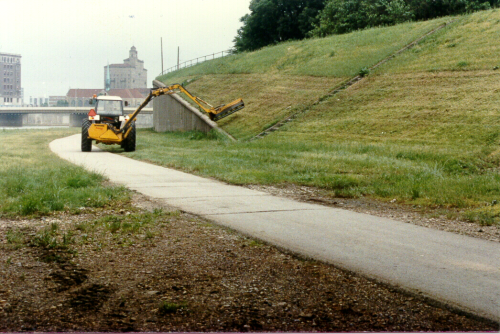
The Miami Conservancy District maintains more than 1,500 acres of levee and dam embankments across Piqua, Troy, Tipp City, Huber Heights, Dayton, Moraine, West Carrollton, Miamisburg, Franklin, Middletown, and Hamilton. Our Operations team lays out exactly why grass — not gravel, not concrete, not shrubs — is the go-to embankment cover:
1. It fights burrowing animals. Groundhogs and other diggers are drawn to the taller, undisturbed cover that turf mowing eliminates. A single burrow can weaken a levee and create a direct conduit for water to seep through the embankment during high water. Keeping grass mowed short, and trees and shrubs cleared back, removes the habitat that attracts these animals in the first place and makes existing burrows far easier to spot before they become a failure point.
2. It exposes sinkholes early. Sinkholes form slowly, often triggered by a failing sewer or water line running under or through the levee, and the internal damage can be extensive long before anything shows on the surface. A smooth, evenly maintained turf surface is what makes it possible for inspectors to catch these problems — soft spots, subtle depressions — while they're still small and fixable, rather than after they've become a safety hazard.
3. It preserves embankment shape. A uniform grass cover keeps the levee's slope smooth and consistent, which matters for water flow and for spotting trouble. Voids and internal instability can exist well before there's any visible sign on the surface, so a clean, well-managed slope is the tool crews rely on to catch embankment problems in their early stages, before they can escalate toward a breach.
4. It's the frontline defense against erosion. Rivers naturally erode and deposit sediment, and the single best way to blunt that erosive force is to keep it from ever touching bare soil. Grass roots bind the soil together while the stems and blades trap fine sediment, forming a living, self-repairing armor layer that's far cheaper than engineered erosion control — and, over 1,500 acres, cost matters.
5. It keeps sediment and debris moving. After high water, levees and beach areas often end up covered in silt, gravel, and debris. Well-maintained turf (with brush kept off the banks) keeps water flow smooth and consistent, so sediment is less likely to stall out and settle in places that clog storm outlets, block floodgates, or redirect flow into the structures themselves.
Put simply: grass is affordable, self-healing, and — critically — transparent. It lets trained eyes see the levee's actual condition. Nothing else does all three at once.

We hear from residents about the geese, and honestly, we get it — they leave a mess, and short mown grass is exactly the buffet-and-lookout combination geese love: easy grazing on the tender new growth, plus a clear sightline in every direction to spot predators. The usual advice for keeping geese off a property is to let the grass grow tall, since geese avoid areas where they can't see danger coming.
That's the trade-off. On a levee, tall grass isn't an option. The same clear sightlines that make mown turf appealing to geese are what let our inspectors spot a groundhog burrow, a soft spot, or the start of a sinkhole before it becomes a safety problem. Keeping the grass short is a life-safety requirement, not a landscaping preference — so as much as we'd like to make the geese less comfortable, letting the grass grow out isn't a trade we can make.
This is the part that surprises people. Homeowners near a levee often assume a stand of mature trees looks protective, even natural. National engineering guidance says the opposite, and our maintenance program follows suit by keeping trees and shrubs cut back from the levees.
What USACE Standards Require
The U.S. Army Corps of Engineers' vegetation standards (most recently codified in Engineer Pamphlet EP 1110-2-18, the successor to ETL 1110-2-583) lay out the reasoning:
That's why USACE standards call for a vegetation-free zone and a root-free zone around levees, floodwalls, and other critical flood structures, with only limited exceptions for select landscaping in specific low-risk, high-visibility settings — and why our day-to-day maintenance keeps woody growth cut back rather than letting it take hold.
Turf management is the headline, but it's one piece of a much longer maintenance list we run across the levee system:
None of these tasks are flashy. That's by design. A levee system is doing exactly what it should when a hundred-year flood comes through and the six o'clock news has nothing to report.
The Great Miami River watershed has flooded catastrophically before — most infamously in 1913, the disaster that led to the creation of the Miami Conservancy District in the first place. Every mowed slope, filled groundhog hole, and cleared sapling since then has been part of making sure that history doesn't repeat itself. It isn't glamorous work, but it's exactly the kind of unglamorous consistency that keeps 47,000 properties directly protected and roughly a million people across the region safe, year after year, storm after storm — even as the same ground doubles as the trail you walked this morning.
Sources: Miami Conservancy District, "Why All The Grass? 5 Reasons We Use Turf On Our Levees" and "Levee System" (mcdwater.org); U.S. Army Corps of Engineers, EP 1110-2-18 / ETL 1110-2-583 vegetation and root-free zone guidance; USACE Engineer Research and Development Center literature review on levee vegetation.

